01 / 11 · Relia Jewelry
Branding Existing Jewelry Designs
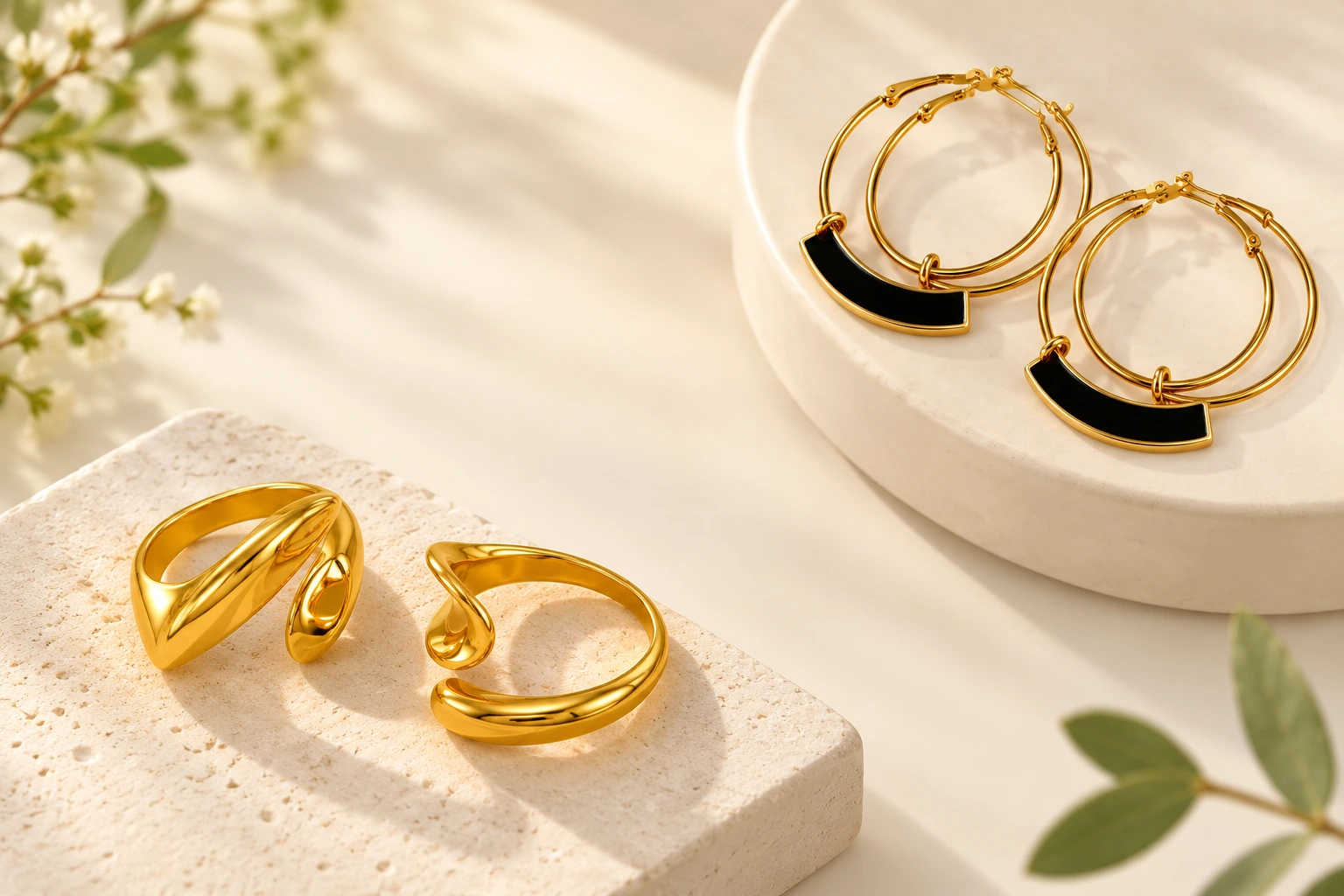
If you like an existing jewelry design and mainly need it to represent your brand, start with private labeling rather than a new product from scratch. We recommend separating the finished design, the proposed name or logo placement, and the presentation so you can see which changes are essential.
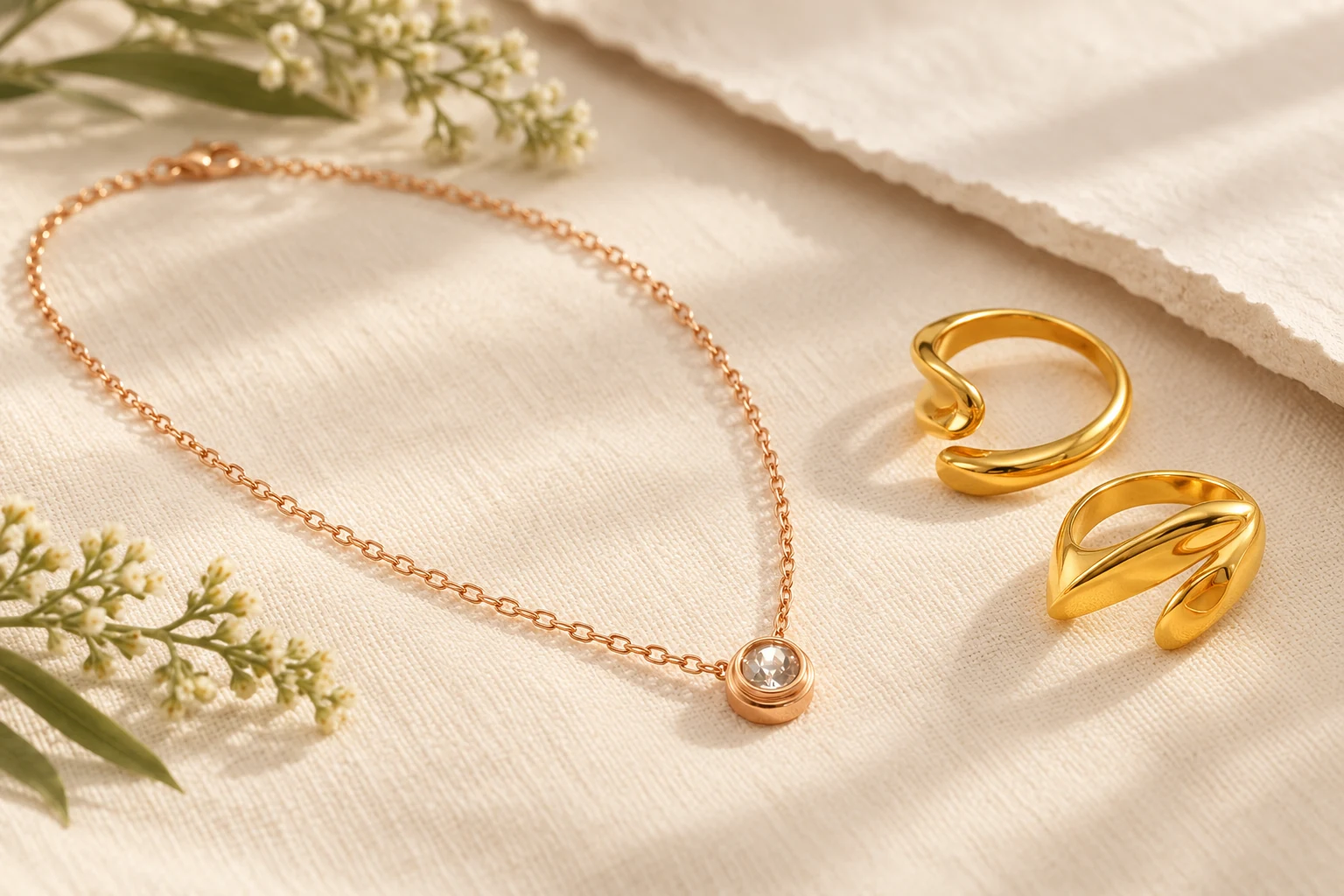
An open ring or chunky hoop is a practical starting reference because the catalog explicitly supports a name or logo enquiry. Keep the photographed construction as your baseline and describe the mark you want, instead of assuming every visible surface can take any branding method.
Explore this guide
- Existing-design route
- Use the six-design open ring or six-choice chunky hoop as the product starting point.
- Branding scope
- Name/logo wording supports an enquiry; engraving method, area and artwork limits still need an agreed proposal.
- Keep presentation distinct
- Describe product marking separately from packaging and supplied retail units.
02 / 11 · Buyer guide
Existing Jewelry and Branding Enquiries at Relia
Relia · In-house jewelry manufacturing in Qingdao, China
Relia supplies existing jewelry designs and welcomes related customization enquiries as a jewelry factory in Qingdao, China. The Gold open-ring range offers six numbered shapes with custom-logo wording; the stainless-steel chunky hoop range offers six Gold design choices with name/logo wording.
These references let you discuss branding on a recognizable product rather than beginning with an undefined collection. You can select the silhouette first, then present the artwork and desired placement for a specific proposal. Neither a logo reference nor a Gold color selection establishes a particular marking process, coating thickness or packaging package.
Select the Right Existing Platform
- Open ringsSix Gold Resizable designs, custom-logo wording · Choose the band silhouette
- Geometric hoopsGold 1–6, name/logo wording · Choose the exact hoop profile
- Paper-pin chainsFive Gold-numbered versions · Choose chain and connection
- Retail presentationSeparate from jewelry options · Choose the intended selling unit
03 / 11 · Buyer guide
Evaluate the Surface Before the Artwork
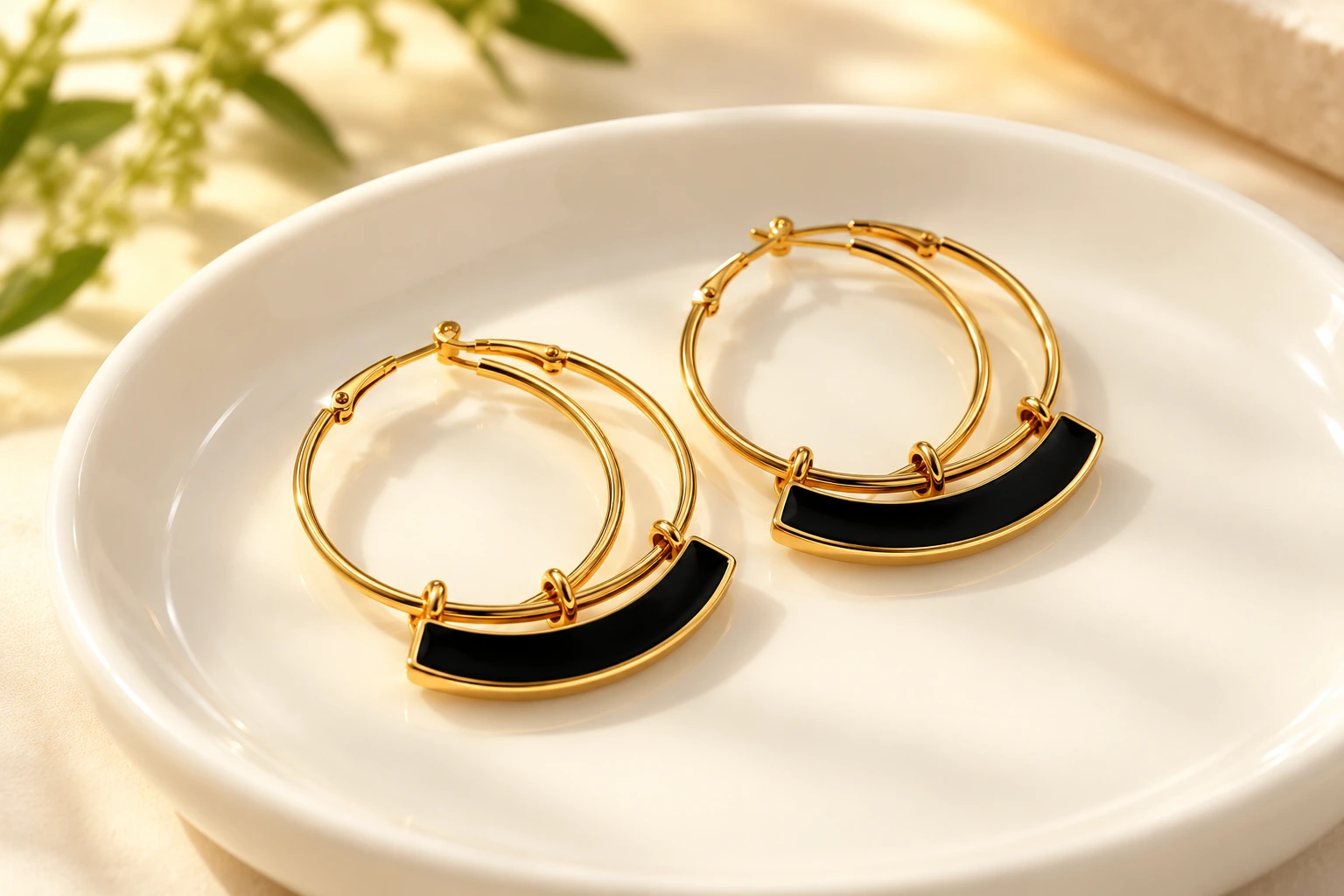
Choose the exact body before placing artwork. A broad smooth surface and a narrow curved edge offer different usable marking space, so assess the face, band interior and proposed logo zone separately.
On geometric hoops, shell or other decoration may already lead the design. Keep the mark discreet where the selected construction supports it.
04 / 11 · Buyer guide
Create a Usable Marking Surface Before Placing Artwork
Relia's in-house forming capabilities allow a brand brief to begin with the jewelry surface itself. A broad flat zone and a narrow curved band offer different space for a readable mark. When the body is developed, its curvature, edge position and decorative relief affect where artwork can sit without competing with the original design.
For the six-design open-ring range or the chunky geometric hoops, select the actual version before sizing the artwork. Define width, height and orientation on that surface, and distinguish a discreet identification mark from a visible retail logo. Cutting a component outline and engraving a surface create different results. Keep the intended logo application and the selected finish together in the custom brief so the mark belongs to the finished design.
Create a Usable Marking Surface Before Placing Artwork
| Body decision | Effect on the mark | Useful output |
|---|---|---|
| Flat versus curved zone | Changes usable artwork space | Placement on the exact selected body |
| Relief and edges | Can compete with or interrupt a mark | Unobstructed width and height |
| Wearing orientation | Determines how the mark reads | Upright artwork direction |
| Selected finish | Marking sequence may affect appearance | Project-specific marking proposal |
05 / 11 · Buyer guide
Keep Personalization Separate from Brand Ownership
An initial selected for the wearer and a logo identifying your business do different jobs. Neither alphabet availability nor name customization grants exclusive ownership of a catalog silhouette.
If exclusivity matters, define it separately. Ordinary private labeling can create consistent presentation without claiming the existing design was developed only for your brand.
06 / 11 · Buyer guide
Choose a Finish that Supports the Collection
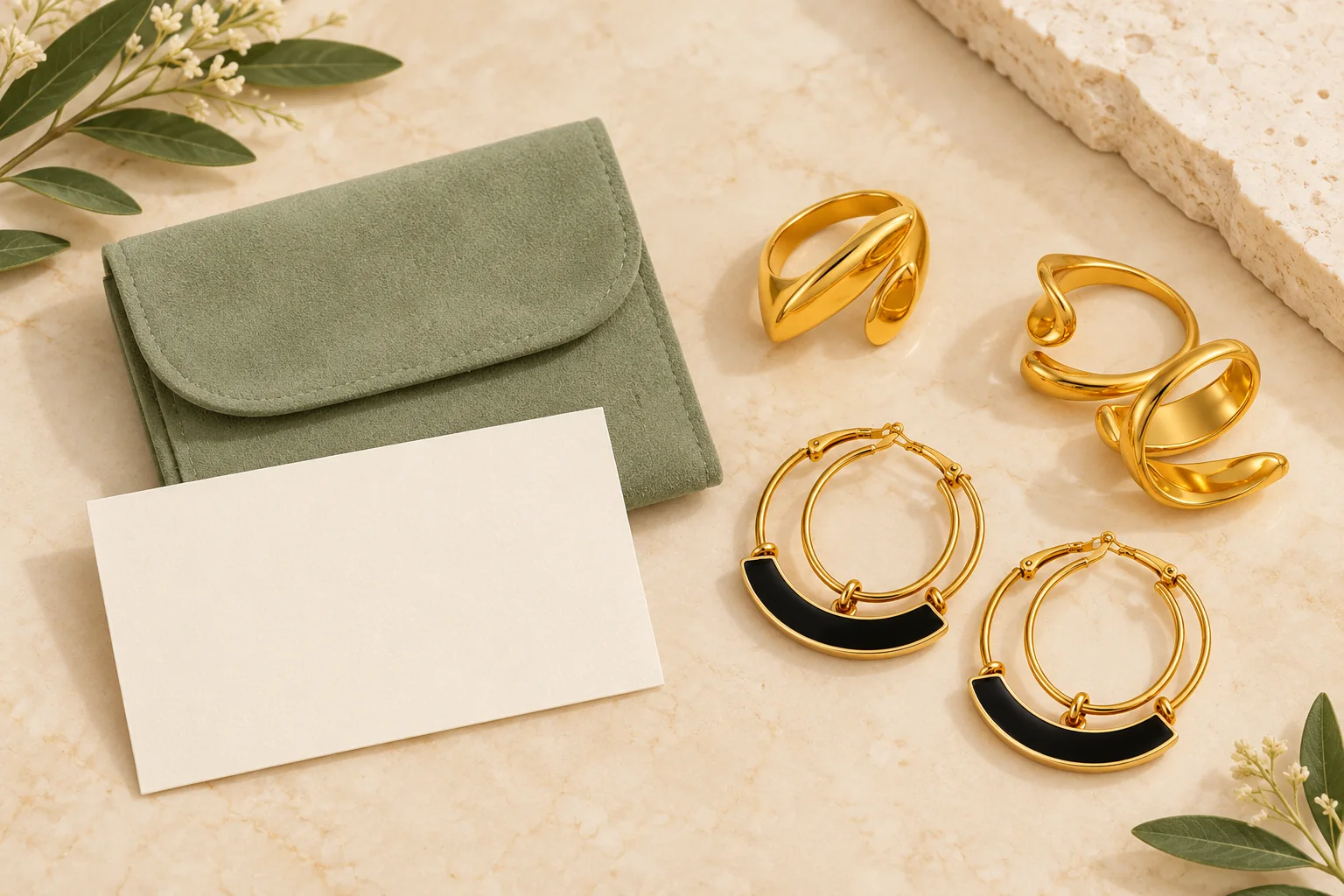
The ring range specifies stainless steel with titanium-plated and 18K-gold-plated directions. The geometric hoops specify 18K gold-plated steel. The paper-pin chain lists several finish descriptions while its actual selectable labels are Gold-numbered versions. Those are not interchangeable coating specifications.
For a coordinated branded capsule, choose the intended metal-tone appearance across your selected pieces and review them together. Do not assume a Gold label on unrelated designs produces an identical hue. The design and its selected finish should stay attached to the marking approval so a later color change does not become an automatic repeat.
Choose a Finish that Supports the Collection
- Open ringsTitanium plated, 18K gold plated · Approve the selected version
- Geometric hoops18K gold-plated steel · Review mark beside decoration
- Paper-pin chainGold/rose-gold/titanium directions · Match the actual numbered option
- Coordinated capsuleShared intended appearance · Compare physical samples together
07 / 11 · Buyer guide
Build the Brand Around the Selling Unit
A single ring, an earring pair and a chain do not need identical retail packaging. Choose a presentation that supports handling and identification first. A card can show a pair clearly; a chain needs restraint that avoids confusing the pendant connection with the closure.
The jewelry and packaging should have separate approvals. A correct logo on a card does not approve the mark on the metal, and a correct metal mark does not approve the printed artwork. Keep the jewelry count and any accessories explicit so the presentation communicates what the customer actually receives.
Build the Brand Around the Selling Unit
- JewelrySelected style and physical mark · Artwork approval mistaken for product approval
- Card or boxPrint layout and product fit · Packaging assumed included
- Selling unitPiece, pair or agreed combination · Photographed assortment mistaken for set
- LabelVariant name and your reference · Similar designs packed together
08 / 11 · Buyer guide
Use a Sample to Resolve the Brand Hierarchy
A useful branded sample shows the finished visual hierarchy: the jewelry motif first, the brand identification where intended, and the retail information in its own place. Review it at normal viewing distance as well as close up. A technically legible mark can still be too dominant for a minimalist piece.
For a mixed range, review at least the distinct surface types you intend to use. Approval on an open ring should not automatically apply to a shell-decorated hoop. Each platform may need a different artwork scale, even when the same brand symbol is retained.
Use a Sample to Resolve the Brand Hierarchy
| Surface type | Sample observation | Decision |
|---|---|---|
| Smooth band area | Mark scale beside ring outline | Retain or reduce visual weight |
| Decorated hoop | Mark beside shell/geometric detail | Keep decorative face readable |
| Chain connection area | Mark does not obstruct fitting | Preserve intended assembly |
| Retail presentation | Jewelry and brand remain distinct | Approve the complete selling unit |
09 / 11 · Buyer guide
Keep Repeat Orders Attached to the Approved Version
Once you accept a marked sample, keep its product option, artwork version and placement together. This matters particularly for six-design ranges, where the same color name can hide different shapes. A repeat enquiry should identify the actual approved combination, not just the logo file.
A later change to size, surface or finish can affect the visible result. Record it as a revision rather than relying on the first approval. This creates a practical distinction between repeating an existing branded piece and adapting the mark to another design in your collection.
Keep Repeat Orders Attached to the Approved Version
- Product versionExact ring or hoop choice · Surface geometry can differ
- ArtworkAccepted file and orientation · Prevents unintended design changes
- Mark locationMeasured approved position · Keeps visual hierarchy consistent
- FinishSelected appearance reference · Color changes affect the result
10 / 11 · Buyer guide
Bring a Specific Private-Label Proposal
Start with existing jewelry that belongs in your collection, then define the artwork and placement that make the range coherent. A few compatible surfaces are easier to evaluate than unrelated pieces.
Keep product options, quantities, selling units and packaging direction with the proposal. Marking, samples, packaging and any exclusivity remain separately defined work.
11 / 11 · Buyer guide
Discuss Your Private-Label Jewelry
Send the existing jewelry reference, your artwork and the intended marking position. Relia can review the base design and proposed branding together with your packaging direction.
Contact Relia by email, WhatsApp or phone. Our company is Qingdao Relia jewelry Co., Ltd., with its company address at Shuyuan Road, Qingdao, Shandong, China.
Contact Relia
- Email[email protected]
- WhatsApp14042030971
- Phone+86 18561762631