01 / 10 · Wholesale jewelry
Selecting Natural-Stone Necklaces and Rings
We are a jewelry factory in Qingdao, China. For a natural-stone line, choose the mineral story and wearing format together. A pendant gives the stone a stable focal position at the neckline; a ring brings it into a more frequently handled setting. We recommend starting with named stone options where mineral identity is central to your product description.
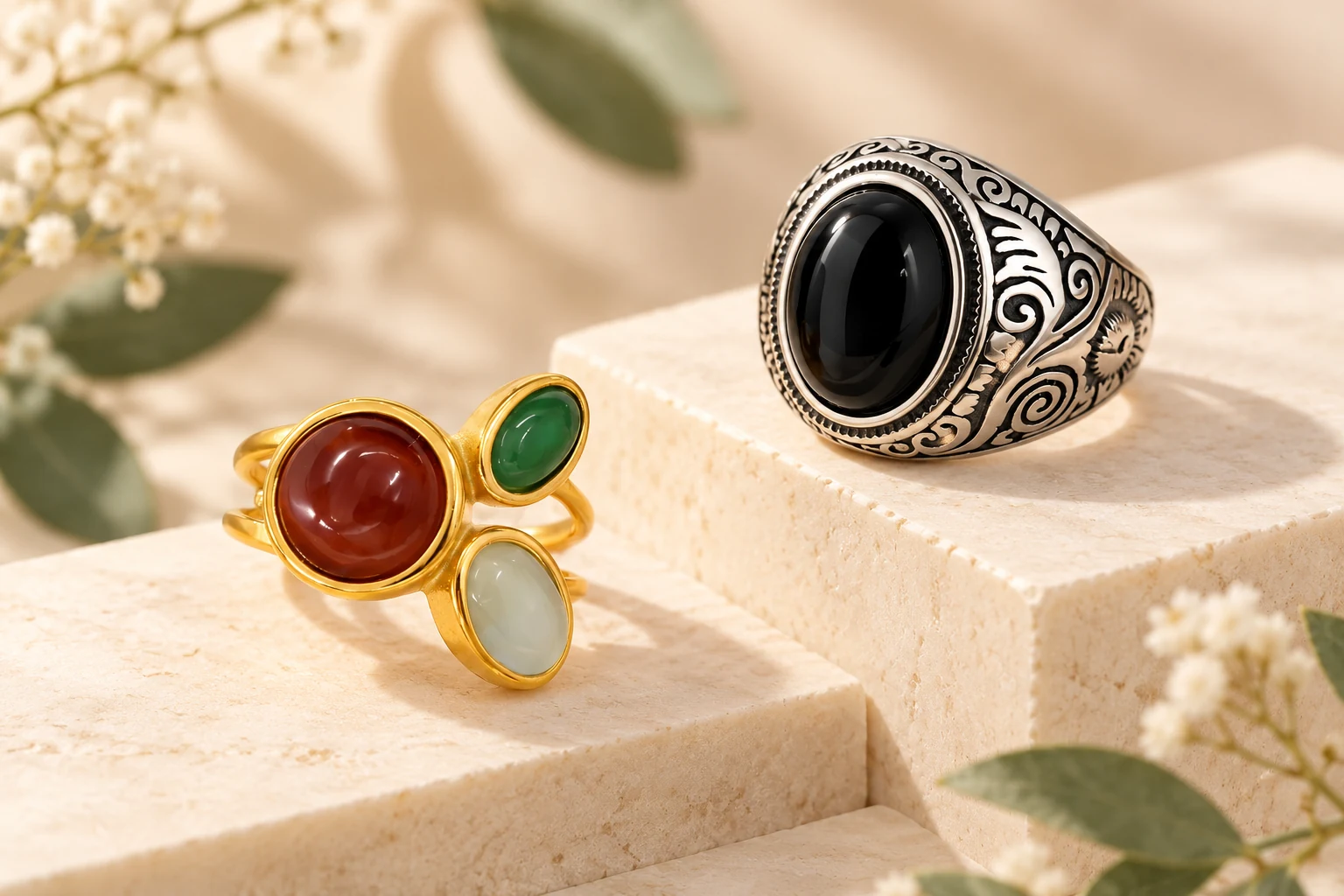
Our 18-inch necklace offers green aventurine, amethyst and rose quartz. The open multi-stone ring offers a different, arrangement-led direction, while the vintage oval ring adds fixed size choices. These are useful alternatives, not one interchangeable gemstone range.
02 / 10 · Buyer guide
Start with the Named Necklace Options
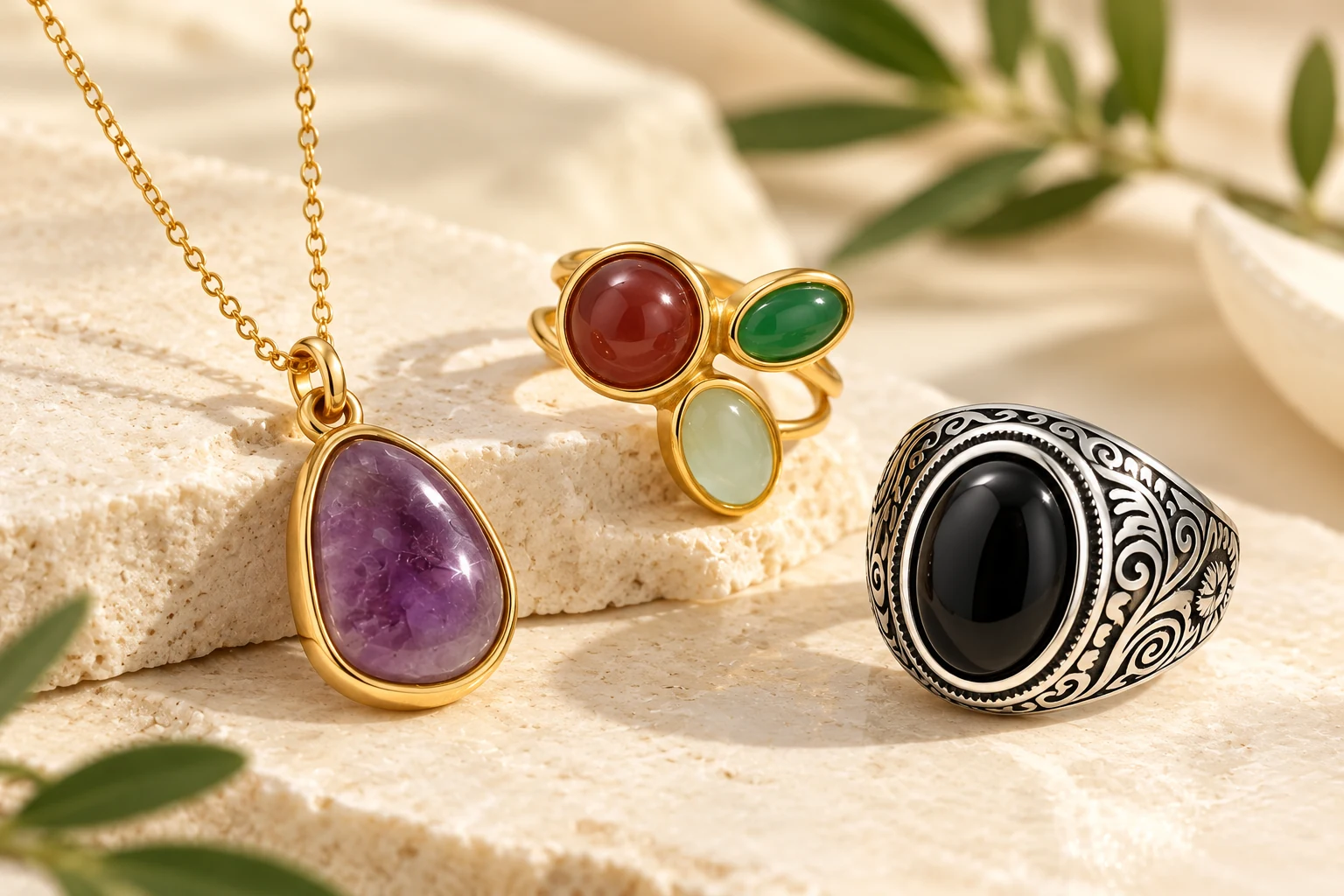
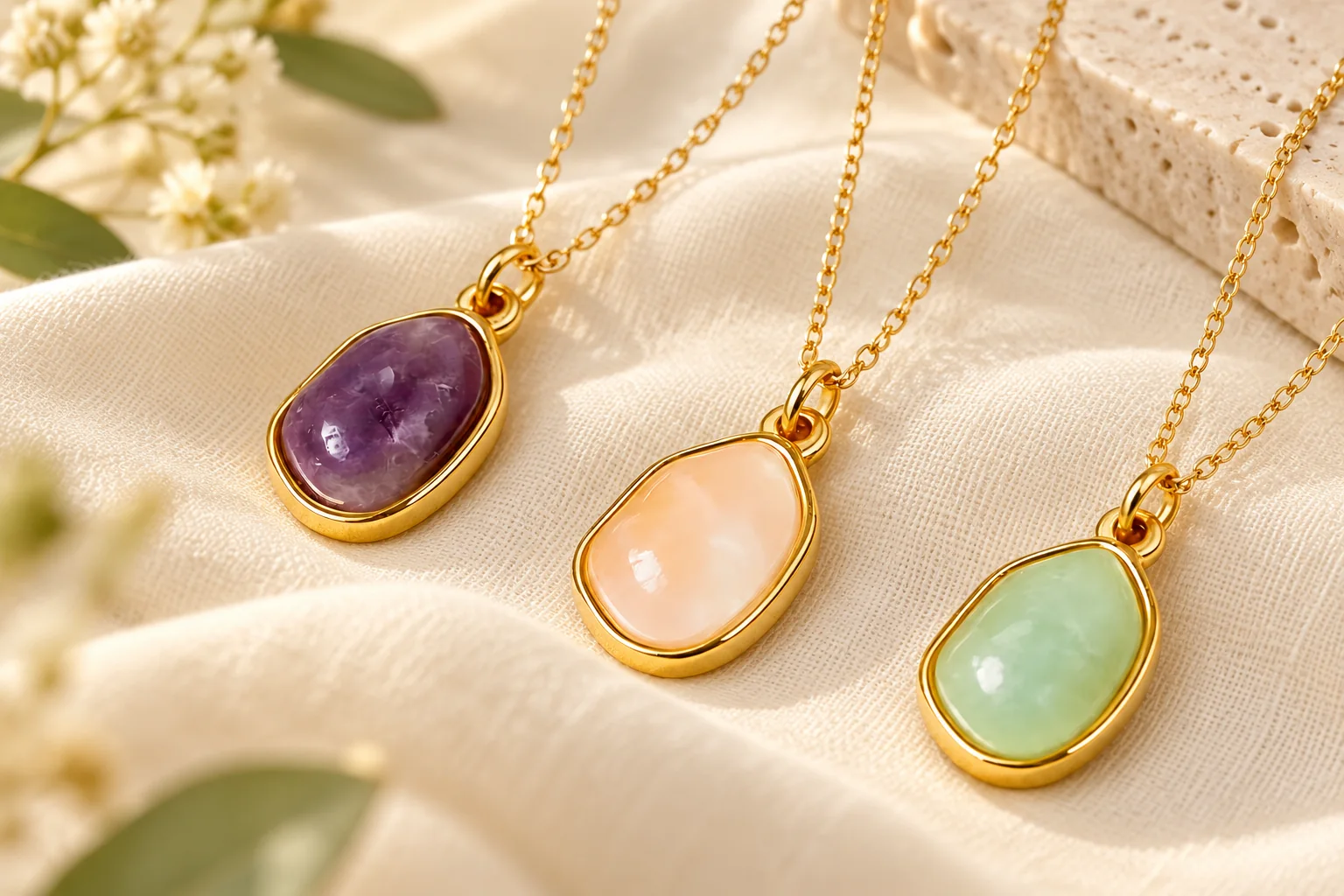
Green aventurine, amethyst and rose quartz are three actual choices on the same 18-inch necklace. The main construction is stainless steel with natural stone and an 18K-gold-plated direction. Because the length is shared, the mineral choice is the principal variation in this range.
Choose green aventurine for the green direction, amethyst for purple and rose quartz for pink, using the selected photograph as the appearance reference. Keep the mineral name in the product data rather than reducing all three to a generic colored pendant. A common chain length does not establish identical pendant dimensions.
Start with the Named Necklace Options
- Green aventurine18inches,plated steel · Green stone direction
- Amethyst18inches,plated steel · Purple stone direction
- Rose quartz18inches,plated steel · Pink stone direction
- All threeNatural-stone description · Selected appearance and dimensions
03 / 10 · Buyer guide
Use the Wearing Format to Narrow the Range
The necklace keeps the stone choice within one known chain length. The multi-stone open ring has Gold or Silver with a Resizable format, but no named mineral options. The vintage oval ring has White, Black, Tiger eye and Blue choices in sizes 8, 9 and 10.
Choose the necklace when you want a named-mineral line with a simple option structure. Choose the open ring when the arrangement and adjustable format are the main attraction. Choose the oval ring when a larger stone-led profile and a fixed size run belong in the assortment.
Use the Wearing Format to Narrow the Range
- Named-stone pendantThree minerals,18inches · Mineral identity and neckline
- Open multi-stone ringGold/Silver,Resizable · Arrangement and usable fit
- Vintage oval ringFour color labels,sizes8–10 · Selected stone identity and size
- Mixed capsuleDifferent formats · Separate descriptions and fit decisions
04 / 10 · Buyer guide
Match Each Ring to Its Actual Stone Option
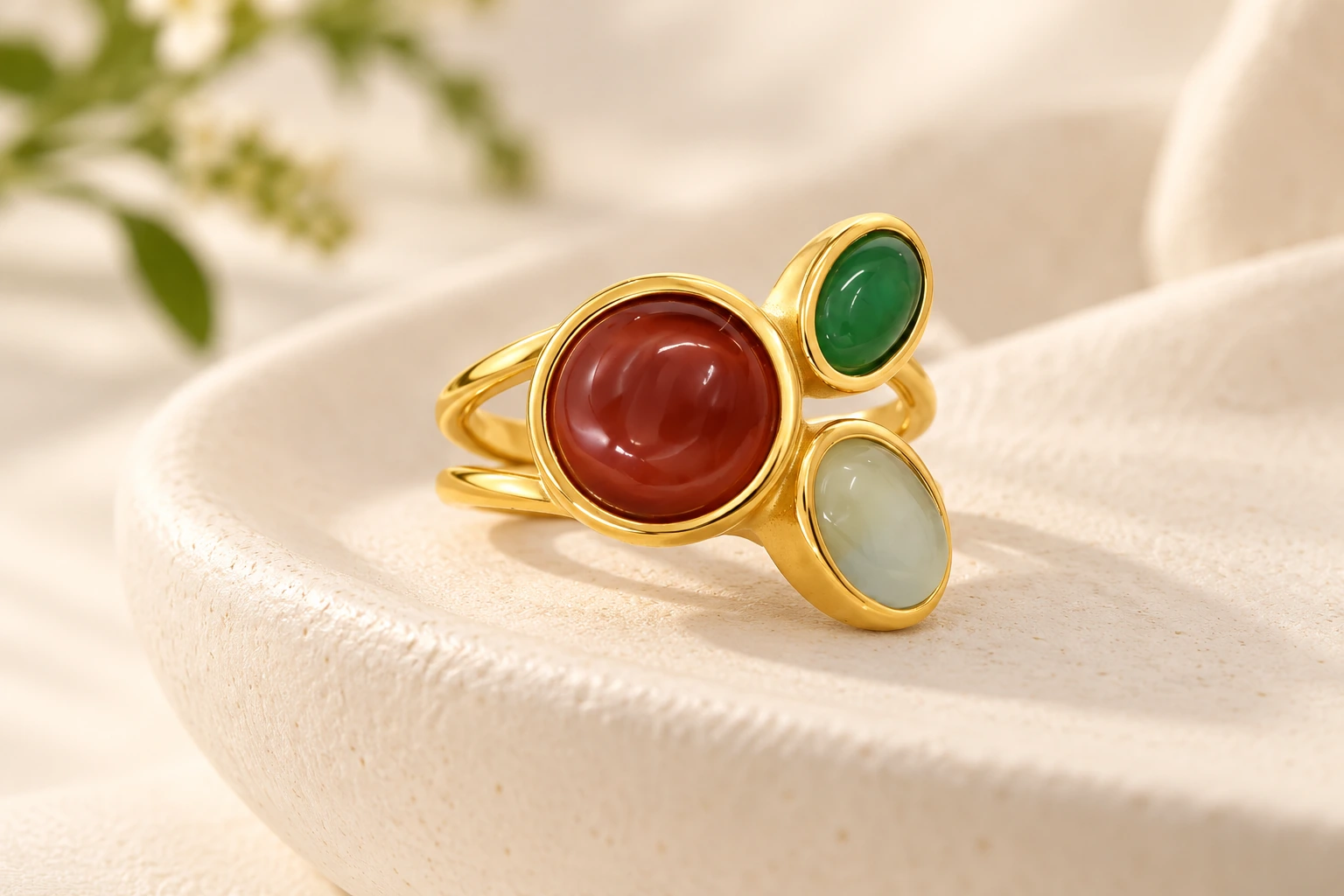
A Natural Stone description identifies a broad category, not a particular mineral. For the multi-stone open ring, select the pictured arrangement and state any mineral-specific requirement separately. Gold or Silver changes the metal-color direction; it is not a menu of stone species.
For the oval ring, keep Tiger eye distinct from the color-only White, Black and Blue labels. A color name alone is insufficient for a mineral claim. You can evaluate the design now while making the exact selected stone identity part of a material-specific purchase. This avoids giving every version one unearned gemstone name.
05 / 10 · Buyer guide
Separate Ring Fit from Stone Scale
The open ring uses Resizable, while the oval ring offers sizes 8, 9 and 10. These are different fit structures. A wide stone setting can also feel and look different from a slim plain band, so the top view is not enough for a useful comparison.
For the fixed-size ring, keep the sizing convention and inner dimensions together. For the open ring, use the workable adjustment range and method. In both cases, record setting height and face dimensions where they affect the intended wearer. The stone's color cannot answer those fit questions.
Separate Ring Fit from Stone Scale
| Ring feature | Open multi-stone | Vintage oval |
|---|---|---|
| Fit label | Resizable | Sizes8,9,10 |
| Actual color options | Gold,Silver | White,Black,Tiger eye,Blue |
| Stone description | Natural Stone | Selected mineral requirement |
| Useful dimensions | Fit range,face and profile | Inner size,oval face and height |
06 / 10 · Buyer guide
Choose Settings for the Intended Daily Handling
A stone pendant and a ring encounter different handling. A ring's decorative face is more likely to meet nearby surfaces during ordinary use, while a pendant's connection and orientation become central at the neckline. Use that difference to decide which format best serves the collection.
For the named-stone necklace, inspect the setting outline and pendant passage. For the rings, inspect the side profile and the relationship between stone and band. We are describing useful buyer review points, not claiming a particular impact test. The aim is to select a design whose construction suits how you expect it to be worn.
Choose Settings for the Intended Daily Handling
- PendantStone setting and connection · Stable focal arrangement
- Open cluster ringStone arrangement and opening · Visual balance with fit range
- Oval ringFace size and side profile · Prominence on the hand
- Coordinated rangeDifferent wear contexts · Do not apply one care promise blindly
07 / 10 · Buyer guide
Give Amethyst and Rose Quartz Distinct Care Notes
GIA gives both amethyst and rose quartz a Mohs hardness of 7, but hardness is not an all-purpose durability guarantee. Its amethyst guidance notes sensitivity to abrupt temperature changes and possible fading under prolonged intense light. Its rose-quartz guidance recommends avoiding ultrasonic and steam cleaning.
Warm soapy water is an appropriate general stone-cleaning reference in both guides, while the complete jewelry assembly still matters. Keep any treatment information with the selected stone. These material facts help you write useful care guidance without claiming that every necklace or ring has been tested under the same conditions.
Further reading: GIA amethyst care · GIA rose-quartz care.
08 / 10 · Buyer guide
Compare Samples for a Realistic Stone Appearance
For the named-mineral necklace, compare the selected stone's color, translucency and overall outline with the look you intend to offer. Natural-stone identity does not promise that every individual component has an identical visual pattern. Use an accepted appearance reference to explain the intended range.
For an oval ring selected by color, resolve the actual mineral identity before publishing a species claim. For an arrangement-led ring, keep the composition and stone placement clear. This produces a more useful product description than either promising exact visual duplication or avoiding all material detail.
Compare Samples for a Realistic Stone Appearance
- Named mineralSelected stone and appearance · Accurate mineral name
- Color-led ringSelected color plus actual identity · Do not infer species from hue
- Multi-stone arrangementPictured layout and component list · Describe the selected arrangement
- Natural variationAgreed appearance reference · Avoid identical-pattern promise
09 / 10 · Buyer guide
Build a Capsule with One Clear Stone Story
A three-mineral necklace family offers a straightforward choice structure because the chain length remains fixed. A ring extension can add variety, but it also introduces fit and a different stone-specification task. We recommend adding the ring only when its role is clear rather than treating every natural-stone item as an automatic match.
If your collection is built around one named mineral, retain that identity across selected pieces or describe the ring as a separate complementary design. Color coordination can be attractive, but it should not be used to imply the same mineral where none has been specified.
Build a Capsule with One Clear Stone Story
- Three-mineral pendant lineShared18inch necklace · Clear options,one format
- Single-mineral storySelected named stone · Other pieces need matching identity
- Arrangement-led capsuleOpen multi-stone ring · Fit and components need separate scope
- Vintage hand-jewelry lineOval ring sizes8–10 · More size allocation decisions
10 / 10 · Buyer guide
Send a Mineral-Specific or Design-Specific Enquiry
Send the exact necklace mineral or ring option, target quantity and the intended material description for your store. Add the measurements and any treatment or identification requirement that matters to the purchase. We can discuss the selected version and applicable sample arrangements.
Choose the named-stone necklace when mineral clarity is the priority, or the ring when its setting and hand-jewelry role justify the extra fit decisions. Keep any required stone identity explicit. A useful natural-stone line combines an attractive design with a description that tells the customer what the selected piece actually contains.